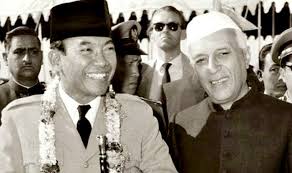
Pandit Nehru, India’s first Prime Minister, had opportunities to get a permanent seat for India in the UN Security Council. However he chose China in place of India and that has had severe consequences for India till today. Here, I examine the evidence to say that Panditji did spurn world offer for the UN Security Council seat, the one that we are still not able to get.
1. The Geopolitical Backdrop: 1945–1955
The UNSC was established in 1945 with five permanent members (P5): the United States, the Soviet Union, the United Kingdom, France, and the Republic of China (ROC). At that time, the ROC was represented by Chiang Kai-shek’s nationalist government, which fled to Taiwan after being defeated by Mao Zedong’s communists in 1949.
However, the West, particularly the United States, continued to recognize the ROC (Taiwan) instead of the People’s Republic of China (PRC) as the legitimate government of China for over two decades. Nehru was one of the first leaders to recognize the PRC diplomatically in 1950 and consistently argued for its rightful place in the UN system.
2. The 1950 Letter to Vijaya Lakshmi Pandit
The most cited piece of evidence is a letter from Jawaharlal Nehru to his sister, Vijaya Lakshmi Pandit, then India’s Ambassador to the United States, dated August 2, 1950:
“Informally, suggestions have been made by the U.S. that China could be kept out of the Security Council and India put in her place. We have refused to be a party to such a proposal because, as we have told them, it would be very unfair for us to take the place of China.”
— Jawaharlal Nehru, “Selected Works of Jawaharlal Nehru”, Second Series, Vol. 15, p. 227
This unequivocally confirms that some form of discussion took place—though informally—between U.S. officials and Indian diplomats regarding India replacing China on the UNSC. Nehru declined, citing moral grounds.
3. The 1955 Note to B.N. Rau
In 1955, Nehru reiterated his view in a note to B.N. Rau, India’s representative at the United Nations:
“India, because of many factors, is certainly entitled to a permanent seat in the Security Council. But we are not going to the United Nations cap in hand and begging for favours. And especially not at the cost of another friendly nation like China.”
— Selected Works of Jawaharlal Nehru, Second Series, Vol. 28, p. 334
This reflects Nehru’s conviction that India should not pursue the UNSC seat at the cost of China’s exclusion, reinforcing his Pan-Asian idealism.
4. U.S, USSR and Western Views: Hints from Declassified Files
The U.S. Proposal to India in 1950
Declassified documents have revealed that in August 1950, the United States informally approached India with the idea of replacing China as a permanent member of the UNSC. This proposal was part of the U.S.’s broader strategy to counter the spread of communism and to strengthen alliances in Asia.
However, Nehru declined the offer. According to a research paper titled “Not at the Cost of China: New Evidence Regarding US Proposals to Nehru for Joining the United Nations Security Council” by Anton Harder :
“Nehru’s rejection of the US offer underlined the consistency of his conviction that the PRC’s legitimate interests must be acknowledged in order to reduce international tensions.”
The Soviet Union’s Proposal in 1955
In 1955, the Soviet Union suggested expanding the UNSC to include more permanent members, including India. This proposal was seen as a move to counterbalance Western influence in the UN.
While the Soviet Union’s proposal did not involve replacing China, it still presented an opportunity for India to gain a permanent seat. However, Nehru remained cautious. He was wary of aligning too closely with either the Western or Eastern blocs, adhering instead to his policy of non-alignment.
Correspondence with Global Leaders
In June 1950, Nehru sent a cable to the Egyptian Prime Minister, urging support for the PRC’s admission to the UN. He made similar appeals to British Foreign Secretary Ernest Bevin, Burmese leader Thakin Nu, and U.S. Secretary of State Dean Acheson. Nehru emphasized that supporting the PRC’s membership was a “realistic and wise recognition of established and indisputable fact as to who effectively controls China” .
Parliamentary Statement – September 27, 1955
In response to a question in the Lok Sabha about whether India had refused a seat informally offered to her in the Security Council, Nehru stated:
“There has been no offer, formal or informal, of this kind. Some vague references have appeared in the press about it which have no foundation in fact.”
Nehru had, for ideological or moral reasons, that went against national interests, decided that China should find a place in the UNSC even though the Soviet Union wanted to have India in addition to China.
5. British Involvement: Evidence from Commonwealth Sources
According to historian Rudra Chaudhuri in “Forged in Crisis: India and the United States Since 1947” (Oxford University Press, 2014):
“In 1955, the Soviet Union proposed a reform of the Security Council membership. Around the same time, the British were exploring with Nehru the possibility of India being nominated as a sixth permanent member. Nehru showed no enthusiasm.”
The British Commonwealth archives indicate that Winston Churchill’s cabinet was open to increasing Asian representation on the UNSC and considered India a suitable candidate. Nehru again declined, this time not out of concern for China, but due to his aversion to appearing opportunistic.
6. Nehru’s Philosophy: Speeches and Public Statements
Nehru’s ideological position was clearly articulated in a 1953 speech to Parliament:
“It would be a disgrace to international diplomacy if the largest nation of Asia were to be excluded from the United Nations and its decisions. China’s place is in the UN, and in the Security Council.”
This statement, given publicly, underscores that Nehru’s actions were not secretive or based on hidden deals. He was transparent in championing China’s global status.
In a letter to the Chief Ministers dated August 2, 1955, Nehru wrote:
“At one stage, the United States did suggest that India might take China’s place in the Security Council… We replied that we could not accept such a position, especially when the great country concerned was not a member of the United Nations.”
7. Indian Diplomatic Testimonies
In his memoir “The Evolution of India’s Foreign Policy”, diplomat K.P.S. Menon confirms:
“We were aware that there were those in the West who wanted India to replace China. But Nehru would not even consider such an idea. He was consistent in believing China had a legitimate claim.”
T.N. Kaul, another senior diplomat, writes in “Diplomatic Channels” (1998):
“Nehru believed that for India to be respected, it must act with moral clarity. He was offered a backdoor into the Security Council—he refused.”
8. Secondary Historiography and Academic Consensus
A number of historians have engaged with this episode:
- Srinath Raghavan, in “War and Peace in Modern India” (2010), writes:“While the offer may not have been formal, Nehru did confront the possibility, and he took a conscious decision to uphold China’s claim.”
- Michael Brecher, Nehru’s biographer, argues:“Nehru viewed the legitimacy of the international order as more important than short-term gains. He understood the strategic value of the UNSC seat, but chose principle over power.”
- Rajesh Basrur, in “India’s Foreign Policy: Coping with the Changing World” (2009), notes:“This is one of those decisions that can be praised for its morality and criticized for its strategic naivety.”
9. Was There a Formal Offer?
This is the crux of the debate. No document has surfaced showing a formal proposal from the United States or the United Nations offering India a UNSC seat. However, Nehru’s own letters and Western archival material confirm informal overtures, and his explicit rejection of those ideas.
The absence of a formal invitation does not dilute the fact that India was being considered and that Nehru had the opportunity to lobby but chose not to.
10. The Strategic Cost: What Did India Lose?
Had India accepted the UNSC seat, it might have gained:
- Veto power over global security decisions.
- Enhanced leverage in disputes, including Kashmir.
- A stronger role in shaping the Non-Aligned Movement.
- More clout in handling China’s rise, especially after the 1962 war.
Instead, India has been lobbying for UNSC reform for decades, with little progress. Ironically, China now opposes India’s bid for a permanent seat.
11. Critics vs. Defenders: The Political Divide
- Critics, including Jaswant Singh, Subramanian Swamy, and others, argue that Nehru’s idealism undermined India’s strategic interests. Singh wrote in “A Call to Honour” (2006):“Nehru’s rejection of the UNSC seat is the greatest diplomatic blunder of the 20th century.”
- Defenders, such as Ramachandra Guha, counter:“India’s moral leadership in the 1950s was built on decisions like this. Nehru wasn’t just a statesman—he was a global conscience.”
12. Conclusion: A Decision That Echoes Across Decades
Even as far as 2019, Finance Minister Arun Jaitley referred to Nehru as the “original sinner” for favoring China over India for the UNSC seat.
The question of whether Nehru declined a UNSC seat is not merely academic—it is emblematic of India’s post-independence foreign policy dilemma: should a rising nation pursue power at any cost, or seek a principled role in shaping global order?
While it’s true that no formal seat was offered, Nehru was confronted with opportunities—informal but actionable—that he declined for moral and geopolitical reasons.
In hindsight, his critics argue that this idealism cost India dearly. His admirers see it as a rare instance of moral diplomacy in an age of realpolitik. But reality is that India has suffered all along as its genuine concerns have been vetoed many times by the five member Security Council.
In addition to Kashmir albatross and unresolved China border issues, this UNSC seat for China is yet another Nehru legacy that India has to live with even 75 years after independence.
Reference
- Selected Works of Jawaharlal Nehru – Second Series, Volumes 15 & 28.
- Foreign Relations of the United States (FRUS), 1950–51, U.S. State Department Archives.
- Rudra Chaudhuri – Forged in Crisis: India and the United States Since 1947 (Oxford University Press, 2014).
- Michael Brecher – Nehru: A Political Biography (Oxford University Press, 1959).
- T.N. Kaul – Diplomatic Channels (1998).
- K.P.S. Menon – The Evolution of India’s Foreign Policy (1963).
- Srinath Raghavan – War and Peace in Modern India (2010).
- Ramachandra Guha – India After Gandhi (2007).
- Jaswant Singh – A Call to Honour (2006).
- Rajesh Basrur – India’s Foreign Policy: Coping with the Changing World (2009).
- T.P. Sreenivasan – “Did Nehru Miss the Bus?” The Hindu, 2010.
 Amaruvi's Aphorisms
Leave a comment