The earliest literary reference to Thiruvattaar Adikesava Perumal Temple is in the Sangam era ( 200 BCE ) Tamil classic ‘Pura Naanooru’ where the poet Maangudi Maruthanar talks about a king by the name Aadhan’ of ‘Vaattaaru’ – the site where Sri Adikesavan resides on the coils of the Aadisesha. This establishes the antiquity of the place.

Later literary and historic references are replete from 700 CE. The Vaishnavite saint poet Nammazhwar pens ten pasurams in praise of Adi Kesavan of Thiruvattar. These are part of the Divya Prabandham collection of poems that the Azhwars had sung in praise of the Lord. Thus Thiruvattar becomes a Divya Desam. There are many other references to the shrine in literature from then on, many in Malayalam, based on the original Sthala Puranam in Sanskrit.
Legend has it that when Brahma conducted a yagyam at Thiruvattaar without consulting his consort Saraswati, the latter ensured that the former uttered some mantras erroneously, thus resulting in materialising two asuras – Kesan and Kesi – a brother-sister duo. Kesan got the boon of invincibility and eternal life from Brahma and later ended up causing immense trouble to the devas and other humans. Mahavishnu had no other option but to contain him within Aadi Seshan and began his eternal sleep on the snake, thus making Kesan a prisoner inside the thousand-hooded snake. Kesi wanted to release her brother and hence made two rivers ‘Parali-aaru’ and ‘Kothai-aaru’ to flood Thiruvattar. Goddess Lakshmi raised the sanctum by five metres and that resulted in the two rivers circling the place as it is today. Hence the name Thiruvattar – the land of encircling rivers.
The temple shot to prominence when Raja Marthanda Varma, who helped found the Travancore Kingdom ( Samasthanam ), won the battle of Collachel defeating the Dutch East India Company after he prayed to Adi Kesava Perumal at Thiruvattar. As a gratitude to the deity, Marthanda Varma showered several gifts on the temple and helped rebuild several portions as well. Later, he replicated the deity as Anantha Padmanabha Swamy at Thiruvananthapuram, albeit shorter than Adi Kesavan by three feet. While Adi Kesavan was 22 feet long, Padmanabha was 19 feet.
The temple of Adi Kesavan is so entwined with the history of Kerala ( formerly Travancore State ) that every significant historical event that had impacted the state has had something to do with the temple and the deity. Dalawai Ramiyan, prior to defending the Travancore against the murderous Hyder Ali, had visited the temple, performed a pooja to the weapons in front of the sanctum sanctorum, taken permission from Adi Kesavan, and thus was able to repulse the attack. One shudders to think what would have happened to the prosperous Travancore State if Hyder’s campaign had been successful. Adi Kesavan plays a significant role here.
The main sanctum houses Adi Kesavan, who has within Him 16008 shalagramams. With a mysterious smile on His face, Adi Kesavan lies on the thousand-hooded serpent, contemplating His next cosmic activity. The three-doored sanctum ( like what one sees at Thiruvananthapuram) brings us to meet Adi Kesavan in His deep silence that brings all our mental agitations to a standstill.
Visiting the temple on a December evening, I had spent around half an hour in front of the deity, while time stood still and I saw all my personal ego evaporate instantaneously. Having been drained of the toxicities in His presence, I had His darshan thrice during the next hour. The temple staff near the one-stone-mantapam that precedes the sanctum smiled in acknowledgement – they might have seen thousands of such enamoured pilgrims for sure.
The main deity Adi Kesavan presents a picture of eternal silence and cosmic contemplation. Brahma is not seen from His navel – signifying that Thiruvattar Adi Kesavan represents the cosmic time when He had not yet created Brahma. Contrast this with Thiruvananthapuram where you see Brahma in the sanctum and you get the picture. Thiruvattar should predate almost all other reclining Vishnu forms in India. The deity is of a ‘suthai’ structure – made of ‘sudu-sarkkarai’, local mud, calcium, and a host of other tantric ingredients that cover the 16008 shaligramams.
The temple follows Kerala-based tantric ritualistic worship that is significantly different from the normal ‘vaikanasa’ and ‘pancha-ratra’ agama worship that is practised in Tamil Nadu’s Vaishnavite temples. The priests are not the regular Vaishnavite ones but the Kerala Namboodiri Brahmins who sport a sandal paste on their forehead, like the other Namboodiri Brahmins of Kerala.
The temple houses several magnificent sculptures that depict both the history and mythology associated with the temple. The ‘Kaalaanthaka’ and ‘Rathi-Manmadhan’ sculptures captivated me so much that I had spent more than half an hour admiring them. Rathi – the female form of love – represents the feminine characteristics in such pristine splendour that I was sure Manmadhan – the male form of love – standing before her would have been captivated as I was. The intense looks that the two shared are visible to even an untrained eye.
It is, however, a shame that some of the sculptures had been refurbished using cement and steel – a grotesque mishandling and molestation of our ancient heritage.
Historian A.K.Perumal, in his Tamil magnum opus, ‘Adi Kesava Perumal Temple – Thiruvattar Temple History’, details the history, social significance, the different sculptures, the land holdings, details of the priestly clans, the different mutts that were prevalent in the town, and many other minute details about the temple. This book is an essential read for anyone interested in the history of the temple.
I felt transported to the times of Raja Marthanda Varma and was lost in time while I was in the environs of the temple. I had regained consciousness and was jolted into the present only when someone’s cellphone rang in a discordant manner – a sudden awakening from a deeply engrossed dream.
The magnificence of the temple can only be understood by being in its premises. Devoid of most modern distractions, Thiruvattar temple represents a time gone by. The temple where time stands still when you have the eyes and ears to see and hear the echoes from the past while being inside its premises. Look more, with fervour, attune your ears to the slowly rising nocturnal noises in the Sree Veli; you could possibly hear the devout march of Marthanda Varma or the clanging sound that the sword made when Deewan Ramaiyan placed it in front of the reclining deity. History resonates from every stone in the temple. Maybe you could see the yakshni that feeds a baby come to life if you could look closer enough.
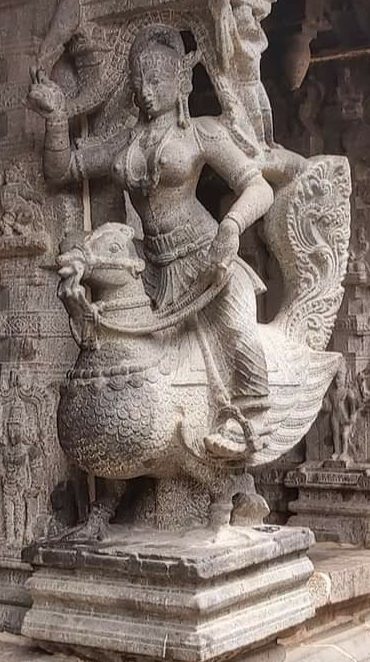
However, exercise caution with the ‘Rathi on the swan’ though, for her feminine extravaganza could enamour you to her so much so that you lose track of time ( like what happened to me ). I began to think that the sculptor should have modelled the ‘Rathi’ structure on the lines of his lover, for I could see impeccable workmanship, dedication, and love in the work.
This is how I thought that the sculptor, possibly her lover, would have envisioned the image :
She leans into the granite pillar as into my ( her lover’s) whisper, the stone softening around her sensuous curves. This is Rathi, goddess of love, gliding forward on her swan-like vāhana, poised between restraint and desire.
Her form flows in languid rhythm: gentle breasts swelling to narrow waist, hips tilting with quiet invitation. The draped garment clings to her thighs, revealing and veiling in one breath; ornaments mark the pulse of longing on neck, arms, and waist.
Confident yet yielding, one arm arches playfully with her emblem, the other draws the eye along her torso. Her smooth, featureless face invites the beholder to imagine beloved features.
Below, the swan mount surges with restrained energy, feathers echoing desire’s waves. In this eternal pose, cold stone throbs with passion—love immortalized in my woman’s graceful, beckoning form.
The Kaalaanthaka sculpture is yet another masterpiece.
Replete with inscriptions dating back to at least a thousand years, the temple at Thiruvattaar lies in its eternal silence, beckoning a weary pilgrim that seeks solace or a history enthusiast that seeks wisdom from those inscriptions and sculptures.
No doubt, Tamil novelist Jeyamohan’s ‘Vishnupuram’ has been inspired by this yet another magnum opus from the past— the Thiruvattar Aadikesava Perumal Temple that lies 30 kms away from Nagarcoil in Tamil Nadu. You could reach from Thiruvananthapuram as well.
A piece of advice : Get inside the temple without any noise-making equipment, for you could disturb the dormant history that sleeps inside the structure. And that includes the reclining Aadi Kesavan.
 Amaruvi's Aphorisms
Leave a comment