Nirupama Subramanian, an Indian English journalist from Tamil Nadu, while working for The Hindu and The Indian Express covering Sri Lanka between 1995 and 2002, records her experience in the island nation in a fiction like format in this delectable book ‘Sri Lanka – Voices from a War Zone’.
The standing out point in this book would be the forthrightness of the author in not trying to camouflage details or take sides. Whether it be an interview with the then Sri Lankan President Chandrika Kumaratunga or her interview with the different victims of the 30 year war, Nirupama presents the conversation in an easily readable and ingestible format.
Her writing goes like this :
- She records a meeting with a victim of the violence.
- Provides a first person view of the incident and the aftermath.
- Makes the victim say, in his / her own words the situation then and the situation at the moment.
- Shifts the narrative to the historical perspective and provides a context to the particular incident.
This format presents itself in all situations. Especially the MBRL ( Multi Barrel Rocket Launcher ) episode is a case in point.
Nirupama presents the need for the MBRL, the urgency of the situation, the dire consequences if the equipment doesn’t arrive on time, who pursues this tool, how does he go about the task of acquiring it, the impediments that he faces in acquiring the weapon, the arrival of the gun at the last moment and then the result of the weapon’s usage. Later the person who acquired the MBRL comes in the book on another occasion to conduct a tour. This connectivity of persons and events goes well with the reader. I liked the intelligent usage of these tactics.
Apart from providing historical contexts and relating them to the current events in Sri Lanka, Nirupama provides contextual clarity of the events by way of travelling to the past immediately after stating a current event. When the reader gets to know the historical or mythical background that is embedded in the subconscious minds of the stakeholders, he is able to see a clear pattern in the current sequence of events that proves the paradigm : history repeats itself. May be mythology too.
Samarth Subramaniam, another author, whose work ‘A divided island ‘ talked about the Sri Lankan conflict, had used the ‘Mahavamsam’ the mythologically written history book of Sri Lankan Buddhism. Other than Samarth, I have seen only Nirupama refer to the book. When an author is able to relate a current event and its sequence to eons of the past, the well roundedness of the analysis comes to the fore. Nirupama Subramanian excels in this. Well done.
Nirupama not only talks about the political and human causality of the war but also the intransigence of the stakeholders, particularly the Tigers and its illogical leader Prabhakaran. She exposes the child soldier recruitment process, the victims of the same, the families affected by this inhuman strategy of the Tigers, the intentional muslim alienation and minority extermination by the Tigers and the complete indoctrination of three generations of Tamils in Sri Lanka. She goes further to expose the hatred that affected Tamils have for the LTTE and its leader.
What the reader repeatedly sees are the peace ventures of the Sri Lankan Presidents Chandrika and Ranil, and the repeated violation of ceasefire by the Tigers. The SLAF’s human rights violations are matched in vigour and tenacity by those of the Tigers – this picture emerges time and again.
Nirupama specifically talks about the famous press conference that the LTTE had arranged and lets known her disappointment at what Prabhakaran said in that. Her conclusion that Prabhakaran was entangled in a cage that he himself had built came out true, as we know from history. EPRLF’s Varadaraja Perumal, in an interview to Nirupama, says that after Prabhakaran’s death, Perumal would be able to freely walk and canvass in elections in Sri Lanka while Prabhakaran would never be able to come out in the open as he had lots of Tamil blood in his hands. How prophetic.
The one item that stands out and appears repeatedly in the book is the constant migration and re-migration of Tamil people from one part of Jaffna to another, one part of Batticaloa to another and from Vavunia to Colombo and Colombo to elsewhere and abroad.
Nirupama captures the poverty of the Tamils and Sinhalese, their attempts to get educated and migrate abroad, and their constant tryst with violence and inland migration.
I could not let go go of this mental picture, even many hours after I had put the book down – that of the child of 12 years, wearing a rubber chappal, yet holding a SLR rifle while standing guard in front of an LTTE office.
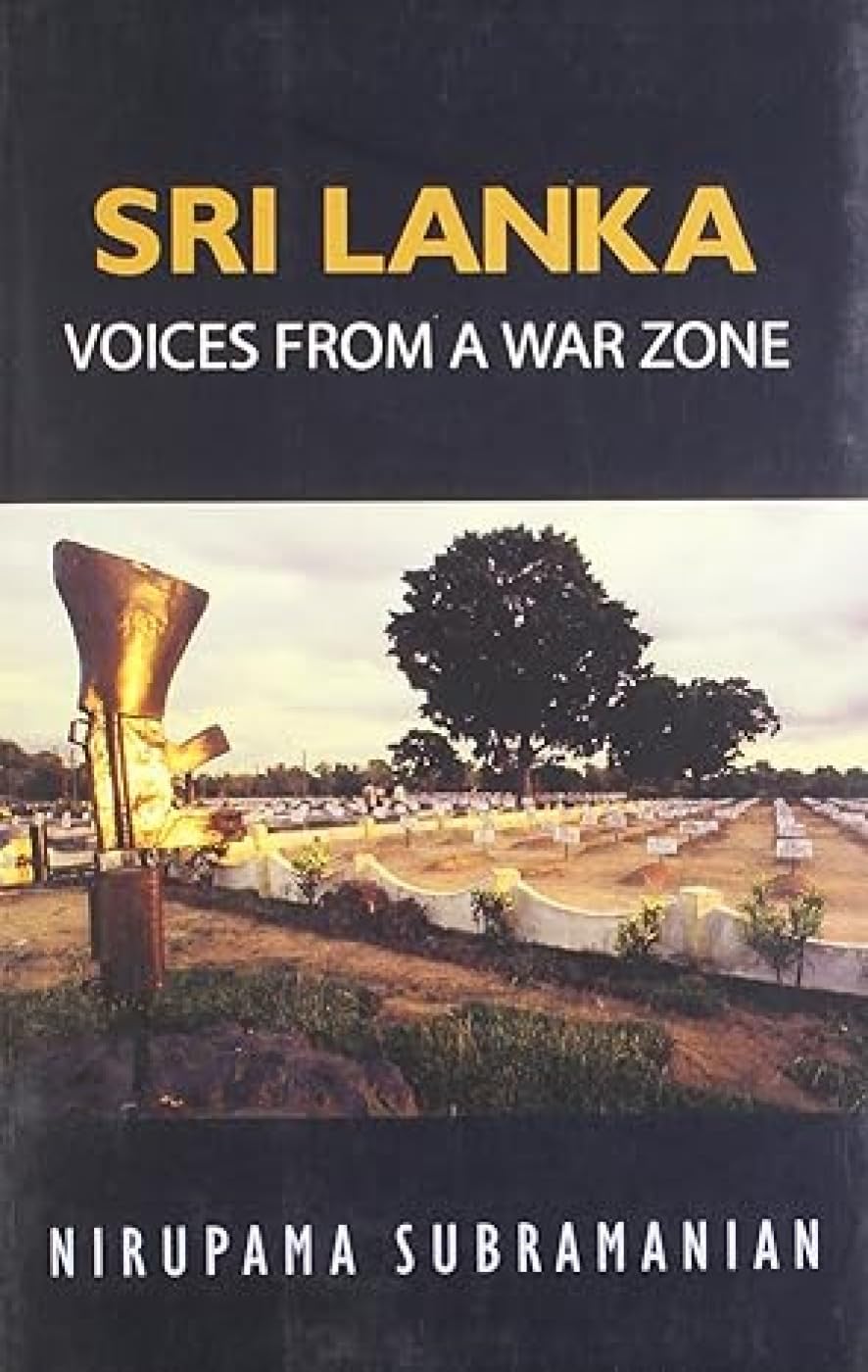
Book : Sri Lanka, Voices from a War Zone. Author : Nirupama Subramanian.
 Amaruvi's Aphorisms
Leave a comment